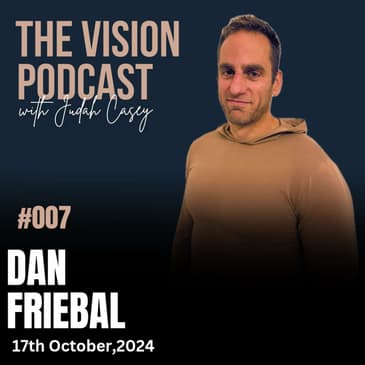
Dan is a business owner, father, and someone who continues to learn. Dan is a good conversationalist and he is someone everyone can learn from. In this episode of the Vision Pod, we talk about fitness, history, and a different variety of topics.
[00:00:07] Welcome back to another episode of The Vision Pod, where guests are hand-picked to bring value to your everyday life. Enjoy!
[00:00:28] Today I'm interviewing Dan Friebel. He's a businessman, big fitness guy, and a father of two.
[00:00:37] Here we go, we're live.
[00:00:39] Alright.
[00:00:40] Today I'm interviewing Dan Friebel. Thank you for joining me, Dan.
[00:00:44] It's my pleasure.
[00:00:45] That's awesome to have you.
[00:00:46] Okay. So, you listen to lots of podcasts. You love the conversation of them. How did you get into listening to podcasts?
[00:00:55] So I was doing construction at the time, and I listened to a lot of music. I was listening to a lot of heavy metal music.
[00:01:02] And coincidentally, at the same time, I was a super angry person. I had a nickname of Angry Dan.
[00:01:07] And everyone knows whatever you put in your head, that's what comes out of you.
[00:01:12] Right.
[00:01:12] And so I was just like, man, I've got to find something else. So, I've always kind of liked history.
[00:01:17] But at the time, this would have been, say, 15 years ago, it's like, do you buy books?
[00:01:23] Like, spend money on books? Or do you buy tapes that people talk about?
[00:01:27] It's like, I don't know what was out there at the time.
[00:01:29] But then I started, like, podcasts. So I just, like, searched on the podcast thing, like, ancient history, Roman history.
[00:01:36] And found this podcast called History of Rome.
[00:01:40] Okay.
[00:01:40] And just, like, binged it and just, like, loved it.
[00:01:43] And actually, like, in the interim, became, like, a happy person.
[00:01:49] And, like, actually totally changed, like, how I saw life.
[00:01:52] And, like, and it was because I started putting, like, different content into my mind rather than, like, heavy metal music.
[00:01:57] Which I still like, but I just don't consume as much of it anymore because of the impact that has on me.
[00:02:01] But, yeah, I started listening to, like, History of Rome.
[00:02:05] Cool.
[00:02:05] And just, like, love history and love, like, self-improvement stuff.
[00:02:09] Leadership stuff is another big, big topic I listen to on podcasts.
[00:02:13] Okay.
[00:02:13] Cool.
[00:02:14] Interviews are, like, interesting people.
[00:02:15] Like, there's, I mean, I listen to a lot of the popular podcasts and I don't listen to everyone.
[00:02:19] But it's, like, if someone interests me, they're like, oh, I want to hear what this person's, like, where they came from or what their history is.
[00:02:25] Then I listen to that.
[00:02:27] That's right.
[00:02:27] That's the most entertaining stuff to watch for sure.
[00:02:30] Yeah.
[00:02:30] So what about history really interests you?
[00:02:34] I think there's so much that you can, like, not predict the future, but, like, history repeats itself.
[00:02:39] And so you can look at history and say, hey, like, what happened back then?
[00:02:44] So you kind of learn lessons and be like, oh, that person did that.
[00:02:47] And that was the outcome they had.
[00:02:48] So if I do something similar, I'd rather have a positive or negative outcome based on the actions that they took.
[00:02:54] But then on a broad scale, you can see, like, where the world is at and be like, oh, like, this is, again, not, like, predicting the future, like, end time stuff or whatever.
[00:03:02] But it's, like, you can just see if we continue on this path or, like, the patterns of behavior or decisions that everyone's making, these are the outcomes that we can have.
[00:03:11] So to me, it's, like, it doesn't make me scared or nervous.
[00:03:14] It's, like, oh, it's, like, this is just where we're going to go.
[00:03:16] So we just need to understand the actions that we're taking will create these similar outcomes that we've had in the past.
[00:03:24] So what was the big, like, eye-opener for you when you read something and you're like, oh, wow, we're doing that exact same thing right now?
[00:03:36] So in ancient Rome, they had, like, the Caesar.
[00:03:39] Well, at one time, anyways, they had, like, as Rome evolved, they ended up having, like, a Caesar who was, like, kind of the head, like the, I guess you'd call them, say, the president.
[00:03:47] Because we would see him.
[00:03:48] And then they also had, like, the Senate who, like, made other decisions.
[00:03:51] And there was, like, nobody was, like, the dictator, even though there kind of was, but it was just, like, there still was, like, had power both ways.
[00:03:59] But over time, the Senate became a body that just kind of wanted that position.
[00:04:07] They wanted just to say I'm a senator because of the notoriety it gave them and it gave them, like, a celebrity status.
[00:04:12] And so they stopped actually doing any work.
[00:04:15] And if you look at kind of where government is going now, and I'd say maybe more so in the States, just because, I mean, we have different bodies of how it works in Canada with, like, a prime minister doesn't have the same power as, like, the president does.
[00:04:29] But you see how those, say, the Democrats and the Republicans, they both vote on party lines, which to me, I'm like, you're not really looking after your people.
[00:04:37] What's in the best interest of your country at that point?
[00:04:39] You're just kind of, you're there for you and to remain in power.
[00:04:43] And so in some ways you're giving up that power and the ability to create change that they once had.
[00:04:50] And the president is gaining more of that power because they are abdicating their responsibilities.
[00:04:56] So that's one thing where I've kind of seen it.
[00:04:58] And, I mean, there'd be scholars that say, no, you're wrong and whatever.
[00:05:01] But I'm like, ah, that's just what I see.
[00:05:02] Right.
[00:05:02] And so I think it'll trend that way.
[00:05:05] And whether that's a good thing or a bad thing, who knows?
[00:05:07] I think it kind of depends on who's in power.
[00:05:08] But, yeah.
[00:05:09] Yeah.
[00:05:10] Huh.
[00:05:10] That's pretty cool.
[00:05:11] Yeah.
[00:05:12] When I think of you, Dan, I think of like a military man or a soldier, a Navy SEAL.
[00:05:18] Is there something that intrigues you about those people?
[00:05:21] Oh, man.
[00:05:22] So much.
[00:05:23] Yeah.
[00:05:23] So I didn't really have a history of like military in my family.
[00:05:26] And I think if I did, I probably would have joined the Army.
[00:05:29] Okay.
[00:05:29] I had one of my grandparents, he was a, he's a pharmacist.
[00:05:32] And so during World War II, he was about to be deployed overseas.
[00:05:35] And the war ended before he went.
[00:05:37] So, and then I have other, like another great uncle or something like that who fought in
[00:05:40] like the Boer War and World War I, but it's pretty far removed.
[00:05:43] So nobody in my recent history.
[00:05:46] And I had a principal in high school who he was just like, you should join the military.
[00:05:50] Really?
[00:05:50] And at the time I was just like, no.
[00:05:52] And the only reason I probably would have said no was because I didn't have any like
[00:05:55] connection point.
[00:05:56] We lived like way far up north.
[00:05:58] There was no like military presence or didn't really understand the possibilities of what
[00:06:03] it was, but I don't regret not doing it.
[00:06:05] But man, I'm just like, oh yeah, that would have been like, yeah.
[00:06:09] Because I graduated high school in 2001.
[00:06:11] So that was like, I would have been primed to go overseas and see some combat.
[00:06:15] So, yeah.
[00:06:15] Yeah.
[00:06:16] So I don't regret it because I mean, I married my wife because we met, went to Bible school
[00:06:20] here in Grand Prairie or Sexsmith and then, you know, just stuck around here.
[00:06:24] So I mean, I wouldn't have known the friends or like had the experiences I would have had,
[00:06:28] but I'm just like, sometimes you think like, hey, what would have life been like?
[00:06:31] What would it look like?
[00:06:32] If I had taken a like different trajectory, like totally.
[00:06:35] Oh yeah.
[00:06:36] And I'm like, yeah, I kind of like to see what the outcome of that would have been.
[00:06:40] But.
[00:06:41] So would you be surprised if one of your sons joined the military?
[00:06:48] I think I would be.
[00:06:49] Oh really?
[00:06:50] Yeah.
[00:06:53] Yeah.
[00:06:53] One of them I went like, one of them is a pretty intense kid.
[00:06:57] So I think he would be the one who would lean more towards it if it was.
[00:07:01] Yeah.
[00:07:01] But I don't really see him doing at this point.
[00:07:03] But I mean, he's like not even in kindergarten yet.
[00:07:06] Right.
[00:07:06] So I can't.
[00:07:07] Who knows what he's going to turn out like.
[00:07:08] Yeah.
[00:07:09] Yeah.
[00:07:09] But at the same time, I thought, hey, would I support them?
[00:07:12] And man, like as a parent, like, yeah, it'd be hard.
[00:07:15] But again, like they're God's kids.
[00:07:17] They're not mine.
[00:07:18] So I'm just stewarding them while they're here.
[00:07:20] So I would want to support them as best as they could.
[00:07:24] Especially for the reasons, like depending on the war.
[00:07:26] Right.
[00:07:26] Because there are some wars that I think have been more honorable than others.
[00:07:29] Right.
[00:07:29] So I think depending on the cause and why he wanted to go, I'd want to support him as much as I could.
[00:07:36] That's cool.
[00:07:37] Yeah.
[00:07:38] You're big into working out.
[00:07:40] Can you tell me a little bit about what the impact of you working out has had in your life?
[00:07:46] Oh, man.
[00:07:48] Everything probably so much.
[00:07:50] Yeah.
[00:07:52] I'm pretty fortunate because I come from a fairly active family.
[00:07:55] So it was just like we always were doing something.
[00:07:58] Like I remember staying with my grandparents and we'd go for like long walks every night.
[00:08:02] Like that's just what they did.
[00:08:03] So it wasn't like the fitness that I'm doing right now is like not something that anybody in my family really did other than my brother now.
[00:08:12] But it was just always being active, like going for bike rides or like, hey, let's go throw a ball around or something anyway.
[00:08:19] So the impact that it's had on me though, I mean, I met my wife because of it.
[00:08:25] Actually, I shouldn't say that.
[00:08:27] I guess we met playing baseball, but we started dating and then she got into fitness and actually became a personal trainer and had her own gym for a while.
[00:08:38] So, I mean, that was a big part of our life.
[00:08:41] And she's still a personal trainer and has now switched into like some social media stuff on the training side.
[00:08:48] But, I mean, everyone knows the benefits of working out.
[00:08:51] Like it's good for your mental health.
[00:08:52] And I've had some dark times over the last couple of years and that's like not the only thing that's got me up in the morning.
[00:08:59] But it's definitely been something that, hey, I'm getting up in the morning to do this and I don't really want to face the rest of the day.
[00:09:04] But I'm going to get up because I want to go work out.
[00:09:07] And yeah, good for your health and fitness.
[00:09:10] And just seeing my boys, like, I mean, I'm 41 and my kids are, you know, I have one kid in grade one and the other one isn't even in kindergarten yet.
[00:09:17] So they're quite young.
[00:09:18] So I want to be as healthy as I can because I'm going to be, you know, 30 some years older than they are.
[00:09:26] So when they're the age of, you know, being way more active than they are now and able to do a lot more things that I can currently do just because, you know, physical limitations of age.
[00:09:35] Then I want to be able to continue to wrestle with them and beat them up as long as I can.
[00:09:39] That's right.
[00:09:39] Yeah.
[00:09:40] Yeah.
[00:09:41] Well, you're, you'll probably be that 18, 18 years old mark where you get tapped out.
[00:09:48] Oh, yeah.
[00:09:48] I don't come.
[00:09:50] Yeah.
[00:09:50] Yeah.
[00:09:50] But that's awesome.
[00:09:53] Yeah.
[00:09:53] So you were saying that you usually work out in the morning.
[00:09:56] What time do you usually get up?
[00:09:57] 4.30.
[00:09:58] Okay.
[00:09:58] Yeah.
[00:09:59] And then you're in the gym for?
[00:10:00] I try to be working out like on the floor by five.
[00:10:03] So, I mean, it's like a eight minute drive to the gym.
[00:10:05] So, you know.
[00:10:07] Okay.
[00:10:07] I leave the house a quarter after and then, yeah, on the floor for.
[00:10:12] What does your workout split look like?
[00:10:15] So I have a personal trainer, so he determines all that.
[00:10:18] So.
[00:10:18] Oh, okay.
[00:10:18] I'd say it's not like a traditional, like, you know, upper body, lower body or push pull.
[00:10:24] It's like today I did chest and some back stuff.
[00:10:31] And then I did like half an hour of progressing intensity cardio.
[00:10:36] So, yeah.
[00:10:38] But some days it's like, yeah, you just do legs and it's other weeks or like training blocks.
[00:10:44] It's like you do all.
[00:10:45] Every day is kind of a full body day.
[00:10:47] But your intensity is maybe lower.
[00:10:49] The volume that you accumulate in a day is lower.
[00:10:52] So, yeah, it's kind of all over the place.
[00:10:54] Yeah.
[00:10:54] Yeah.
[00:10:55] Okay.
[00:10:55] What's a common misconception that you usually hear about in the fitness world?
[00:11:00] Oh, man.
[00:11:01] Or a couple.
[00:11:02] This could go on for hours.
[00:11:05] Okay.
[00:11:05] Man.
[00:11:06] So I think the most recent thing I saw, and I don't know if it was an ad or how it popped
[00:11:10] up, but it was like, someone was just like, oh, you want to work out your glutes?
[00:11:13] Do like a wide-legged squat.
[00:11:16] And it's that whole idea.
[00:11:17] Like someone comes up with an idea to like sell a program or be like, oh, you know,
[00:11:22] sell to grow your glutes.
[00:11:23] Like this is a special exercise you got to do.
[00:11:25] And it's like, no, your glutes are activated when you hinge at your hips.
[00:11:29] So when you bend over, and so it's like, it doesn't matter if your legs are wide or
[00:11:33] narrow or whatever.
[00:11:34] You're going to be working out your glutes just by squatting.
[00:11:38] And it's not like that's your, your dominant muscles are going to be your quads.
[00:11:41] But because you're, you're still hinging at your hips slightly, you're still going to
[00:11:45] be working out your glutes.
[00:11:46] So it's, it's that kind of idea that you got to like do a, do like a specific or special
[00:11:54] exercise to like get these results.
[00:11:56] And there's nothing special about like working out.
[00:11:58] It's just, it's just a grind.
[00:12:00] So it's like, there's going to be exercises that will target certain muscles better than
[00:12:05] others.
[00:12:05] But really it's just about doing the work and, and not being like, oh, like this is the
[00:12:13] hack for something.
[00:12:14] So get rid of like the hacks, like everything is going to have a benefit.
[00:12:17] Like if you, you know, take creatine, you're going to have say a 2%, you know, advantage
[00:12:23] over someone who doesn't, depending on how your body adapts to it.
[00:12:26] Like maybe your body already produces more creatine because it's an, it's naturally in
[00:12:30] food.
[00:12:30] So maybe you already have more in you, but so if you're deficient, then you might see
[00:12:34] more of a benefit by taking it than not.
[00:12:37] But you're still probably going to have a bit of a benefit by taking it, but it's not
[00:12:41] going to turn you into like a bodybuilder.
[00:12:44] You still got to put in the work.
[00:12:46] And the other big thing I'd say is a misconception is nutrition is it's like you can have a 1980
[00:12:55] Toyota Corolla, which I think was my first car, or you could have like a brand new, like,
[00:13:00] well, I'm not, it's not brand new, but say a Dodge Viper.
[00:13:02] Cause that's like my favorite car.
[00:13:03] Sure.
[00:13:03] Yeah.
[00:13:03] So you can have either of those cars and they can both be sitting on the driveway, but
[00:13:07] if you put diesel in them, it doesn't really matter.
[00:13:10] Like they're both going to fail, right?
[00:13:11] Cause they're not, they're not made to have diesel.
[00:13:13] So if you're going to put crap food in your body, then that's the same thing.
[00:13:17] Like you want to put the best thing that you can in these cars to achieve the performance
[00:13:20] that you can.
[00:13:21] Yeah.
[00:13:21] So, um, and one, I mean, they're going to perform differently and, but that's like our bodies
[00:13:26] as well.
[00:13:27] Like everyone is, is, it's going to be different in the gym.
[00:13:29] Like some people are just genetically going to have more advantages than others, but
[00:13:33] that doesn't mean you can't do things to, um, to improve on your own abilities, but you
[00:13:39] still have to put the right fuel in your body.
[00:13:41] So again, it's, there's no like secret to working out.
[00:13:46] It's, it's hard work, but that's only like 20% of it.
[00:13:50] The other 80% is what you're going to do to your body to like fuel it and take care
[00:13:54] of it.
[00:13:54] Yeah.
[00:13:54] So have you, uh, like, have you dropped a sugar or anything like that?
[00:14:02] Like, like a high sugar, the opposite, the opposite.
[00:14:06] Yeah.
[00:14:06] Okay.
[00:14:06] So, so when I started at the gym I'm at now, I was grossly under eating like for, for what
[00:14:14] I needed to do to put on muscle, like both protein and carbohydrates, because if you want to
[00:14:19] like add muscle, then you need to, then you need to eat more than you, than your body needs
[00:14:26] just to survive.
[00:14:27] So if you're like base calorie for like just surviving, maintaining a say 2000, if you're
[00:14:33] wanting to put on muscle, well, you need to do more than that because your body's going
[00:14:37] to require more energy and it's going to require more protein to, to build that muscle.
[00:14:40] So protein is going to build the muscle and the carbs are going to give you the energy.
[00:14:44] Okay.
[00:14:44] So I started eating, what was I, my macros were like 650 grams of carbs and 225 grams
[00:14:51] of protein.
[00:14:52] And I forget what the fats were, like say 75 grams of fats, which you still need fats.
[00:14:56] There's nothing wrong with, with fats.
[00:14:57] You need that.
[00:14:58] Yeah.
[00:14:58] Yeah.
[00:14:59] Um, but to eat 650 grams of carbs in a day, like that's like, I don't know, like three
[00:15:06] loaves of bread.
[00:15:07] Like you just, you physically can't do that.
[00:15:09] So it's like, okay, how, how do you get that amount of food into your body?
[00:15:13] Right.
[00:15:14] And so, I mean, I drink a lot of juice and juices, just sugar, right?
[00:15:19] Like it's just, just fruit.
[00:15:21] So there's, there's a lot of sugar in that.
[00:15:23] And then I also eat a lot of candy.
[00:15:25] I love candy.
[00:15:26] So I eat a lot of candy.
[00:15:27] Okay.
[00:15:27] And again, like it's just, that's, that would be another misconception is like healthy carbs
[00:15:32] or bad carbs.
[00:15:33] A carb is a carb, like a carb if it's in bread or sugar or I don't know what else in fruit
[00:15:39] or like weed or I don't know what, but like it's, they're all the same.
[00:15:43] And now if, if all I were to eat were just like candy, if I were to eat like candy, protein
[00:15:48] powder, and then just like butter, you do okay for like a month, but after a month, like
[00:15:54] you know, your body would start being like, Hey, this is unhealthy.
[00:15:57] I'm not getting all like the other nutrients and vitamins that you need.
[00:16:00] So you still need to eat a balanced diet, but you can't eat like 650 grams of broccoli,
[00:16:09] like carbs worth of broccoli.
[00:16:10] Like, so, so as long as you're getting in like the, the base amount of like healthy nutrients
[00:16:15] that you need and then, Hey, I'm going to supplement this with juice or I'm going to
[00:16:19] eat a bagel or I'm going to eat just like white bread or, or like I said, just drink
[00:16:25] juice or carb line, which is just like, just like a different form of carb.
[00:16:29] Then it's like, yeah, that's, that's okay.
[00:16:32] And, and I've been doing it for like a couple of years and I mean, people think I'm pretty
[00:16:38] healthy.
[00:16:38] Right.
[00:16:38] And I know guys who've been doing that for way longer and they're healthy as well.
[00:16:42] So yeah.
[00:16:45] So I think sugar is just fine.
[00:16:47] Yeah.
[00:16:47] Yeah.
[00:16:48] I remember, I remember hearing of there was ants and there was two piles, there was a pile
[00:16:52] of cocaine, there's a pile of sugar and the ants, the ants would go back to the
[00:16:55] sugar.
[00:16:56] Cause it's more, yeah, apparently it was more addicting.
[00:16:59] Yeah.
[00:17:00] And you know that, this is why I tend not to like, this is, this is for me, I'm not giving
[00:17:03] advice.
[00:17:04] I'm not a personal trainer, but I can self-regulate my own food fairly well.
[00:17:08] And so I know if I like, okay, I need to eat less or I need to eat more.
[00:17:13] Generally I need to eat more food just cause trying to like always like bulking is what
[00:17:17] I feel like.
[00:17:18] Um, so I can regulate those things and I can like cold turkey, cut it off pretty easily.
[00:17:22] Yeah.
[00:17:23] Cause I've done some things in the past where it's like, okay, I'm going to like stop
[00:17:25] lifting weights and I'm just going to run cause I wanted to say, do the death race.
[00:17:29] So it's like, Hey, you want to be lighter rather than heavier for the death race.
[00:17:32] So what's an easy way to do that?
[00:17:33] Well, I just cut out all the snacking that I was doing and I'd lose like, you know, 10,
[00:17:37] 15 pounds in a month or two.
[00:17:39] So, and that's, you know, so I can do stuff like that.
[00:17:43] And not that I'm better than anyone else.
[00:17:44] Like there's lots of people who are able to do that, but you just do have to be careful
[00:17:48] if you're someone who does get addicted to those kinds of things and can't cut it off.
[00:17:51] Be like, Hey, maybe, maybe I'm not going to eat as much sugar or, or stay away from some
[00:17:56] of those kinds of things.
[00:17:57] If you're going to have a problem with that.
[00:17:58] And again, when I'm talking about sugars, it's like, I'm not eating chocolates.
[00:18:02] I'm not eating donuts because those are fatty things, right?
[00:18:05] Cause you got a lot of fat, butter and chocolate or milk, fat and chocolate.
[00:18:09] And then in donut, you're going to get like tons of butter, which again, like I'll eat
[00:18:13] those, but I'm not going to be like, Oh, I'm going to eat this to get my carbs.
[00:18:16] I'll eat it because I'm like, Oh, Hey, I have room in this in my day or I just want to
[00:18:22] enjoy it.
[00:18:22] Like there's, there's nothing wrong.
[00:18:23] I'm not like so strict on my diet either.
[00:18:26] It's like, I'm still going to enjoy life and, and whatever else I'm just, I'm not
[00:18:30] going to eat a donut every day, but you know, if I go by someone's house and they have donuts
[00:18:35] there or cake or whatever, and I'm like, I want it, then I'll have it.
[00:18:37] If I don't want it, then I just won't eat it.
[00:18:39] You'll go to, you'll go to wing Wednesday.
[00:18:42] Yeah.
[00:18:42] Yeah.
[00:18:42] For sure.
[00:18:43] Like, yeah, I'm not opposed to that.
[00:18:44] Yeah.
[00:18:45] So that's again, like I, when I'm eating candy, it's like say a jelly bean or, or a chewy
[00:18:51] candy.
[00:18:52] That's just straight carbs.
[00:18:53] It's not, it's not a fatty carb.
[00:18:55] So, so when I'm doing that, when I'm talking about eating candy, it's just, it's just straight
[00:19:00] sugar.
[00:19:00] So not a fatty sugar.
[00:19:02] So yeah.
[00:19:02] Yeah.
[00:19:03] Uh, I got another question here.
[00:19:05] How important has, uh, mentors been in your life?
[00:19:10] Oh, very important.
[00:19:12] I think that's one place where I'd say like our, again, I don't know how other societies
[00:19:20] work, but I've seen like, cause we've lived in overseas and we've lived in some different
[00:19:23] countries.
[00:19:23] So I've seen some different things, but I think we, we don't put enough of a, um, we
[00:19:32] don't understand the benefit of it enough.
[00:19:34] So I, I initially was like a carpenter.
[00:19:38] So I went to school and you're basically apprenticing.
[00:19:41] So you're supposed to be working under someone else, which I'm doing this.
[00:19:43] Like that's how you learn stuff.
[00:19:45] The best is like, for sure.
[00:19:46] You learn from someone who's done it before.
[00:19:47] Not, not like a business, uh, professor.
[00:19:51] Yeah, exactly.
[00:19:52] Yeah.
[00:19:53] Yeah.
[00:19:53] I'll tell you a story about that in a second too.
[00:19:55] So, so you're learning from somebody who's done it before.
[00:19:58] So not that you don't make mistakes or you don't want to learn stuff on your own.
[00:20:01] Cause I mean, it's not like someone's looking over your shoulder all the time when you're
[00:20:04] building a house, but it's like, you know, someone comes by and checks on you once your
[00:20:07] day or like, Hey, you have a problem and you call somebody and you work through a solution.
[00:20:11] And then now you know that now you can continue going and build on that and build on that
[00:20:15] till you don't need somebody as much.
[00:20:17] So, and that's just like one area of life, but there's so much of life like dating or
[00:20:22] marriage or like having kids or business or like, I don't know, how, how do you write
[00:20:29] a check?
[00:20:29] I don't like whatever it is.
[00:20:30] Like it's nobody likes making a lot of mistakes in life.
[00:20:34] And so if you can avoid some of that by having a mentor, then I think that's really important.
[00:20:37] So the Bible school I went to really emphasized discipleship, which is just another word for
[00:20:43] mentorship.
[00:20:44] It's just like the spiritual version of it.
[00:20:48] So we were supposed to have a discipler all through Bible school, but then as we, Eugene,
[00:20:54] you went on in your year.
[00:20:55] So after you're like your second or third year, then they kind of expect you to start having
[00:20:58] a disciple yourself or a mentor yourself.
[00:21:01] So you kind of got both sides of it.
[00:21:02] You learn how to mentor somebody, but then you also were continually mentored by somebody
[00:21:06] older and wider than you were.
[00:21:08] So generally in your fourth year, it was like, you know, you have a teacher or a professor
[00:21:11] or some faculty member would be mentoring.
[00:21:14] You know, it wouldn't be a student any longer.
[00:21:17] So after Bible school, I was just like, Hey, how come nobody does this like in the world,
[00:21:21] like talking to your friends and nobody has a mentor?
[00:21:23] Like, and I was just like, man, this is, this is something that I want.
[00:21:26] Not that I had a specific need, but I'm like, we were told to do this.
[00:21:30] This is the biblical model, but nobody does it.
[00:21:32] So, so yeah, like let's, let's try and figure it out.
[00:21:36] So I, I kind of like prayed about it and was like, just looking at a couple of different
[00:21:39] guys.
[00:21:40] But then I went on a missions trip with, with a guy who's currently mentoring me and I
[00:21:44] didn't know him really well.
[00:21:45] I knew his son, but he said a couple of things during that, during that trip that I was like,
[00:21:49] Oh man, this guy, like he has a vision and a plan for his life and he knows where he's
[00:21:53] going.
[00:21:54] And it's like, when you see that it's very, um, attractive and appealing to be like, Hey,
[00:22:00] I want to like, I want to be alongside this guy and figure to help me figure things out
[00:22:05] because he's got his, his stuff figured out.
[00:22:07] So, so when we got back to Canada, then I think we ran into each other say six months later
[00:22:12] and I was like, Hey, are you, would you be willing to, to disciple or mentor me?
[00:22:16] And so we kind of talked about it for a bit and then he came back four months later and
[00:22:19] he's like, okay, let's, let's do this.
[00:22:22] And so that was probably 12 years ago and we, we started meeting about once every four to
[00:22:27] six weeks and.
[00:22:29] Wow.
[00:22:30] Yeah.
[00:22:30] Like why wouldn't you meet with someone who's already, already gone through what you're
[00:22:35] going through?
[00:22:36] Yeah.
[00:22:36] Yeah.
[00:22:37] And so when that initially happened, when I first told, like he said yes and I started
[00:22:40] meeting with him and you know, I was excited about it.
[00:22:43] So I told some of my friends and they're all like, Oh, that's a cool idea.
[00:22:45] And I'm just like, well, why don't you find somebody to ask?
[00:22:48] Because I mean, he could have said no, he was a super busy guy.
[00:22:50] And when I approached him, I'm like, Hey, I know you're super busy, but like, will you make
[00:22:55] time for me?
[00:22:56] And he was willing to do it.
[00:22:58] But like very few people ask and I don't know, I don't know why.
[00:23:01] Like he could have said no.
[00:23:02] And what would have happened?
[00:23:03] I don't know.
[00:23:04] I would have found someone else like that's, or I just would never have had a mentor.
[00:23:09] I don't know.
[00:23:09] But like, yeah, I didn't ever understand why people just wouldn't ask somebody.
[00:23:13] Yeah.
[00:23:14] Just find somebody who you like, you kind of look up to.
[00:23:16] Doesn't cost you anything to ask?
[00:23:18] No, no.
[00:23:18] And I think generally people are going to want to say yes, because most people kind of want
[00:23:23] to be helpful and want to be like, Oh, this person like values me and they want to hear
[00:23:27] my wisdom.
[00:23:28] And I think it's, it can be intimidating because it's not a concept that we're familiar with.
[00:23:34] Be like, Oh, how do you do this?
[00:23:35] And so I'm sure there's models or something you can find online to be like, how do you
[00:23:40] start doing this?
[00:23:40] But at this point it's like, we just have a friendship.
[00:23:42] So it's like, it's not that we're going that every, you know, every four or six weeks when
[00:23:47] we meet and being like, Hey, like these are the issues that I'm dealing with.
[00:23:51] It's just like, Hey, like how's life going?
[00:23:52] And so it's, it's become like a friendship now.
[00:23:54] And we're actually business partners in some things too.
[00:23:57] So it's like, it's created a different dynamic in our relationship, but it's, yeah, it's.
[00:24:03] That's interesting being, um, business partners.
[00:24:06] Cause you kind of, would you say he kind of like built a, like a, another, like a clone version
[00:24:13] of him?
[00:24:14] Not exactly, but.
[00:24:15] No.
[00:24:15] And I would say that was never his intent to, to even be a business partner with me.
[00:24:20] I think like it's something he was open to cause he's, I mean, he's partnered with
[00:24:23] many different people in the past and had numerous businesses, but it was never something like,
[00:24:27] Oh, I'm going to like mentor Dan so that, you know, one day I can be a 50, 50 partner, whatever
[00:24:32] percentage partner he wanted to be at the time.
[00:24:34] Right.
[00:24:34] Like, and, and just, you know, just give him some money and he can go run a business.
[00:24:39] It was never that.
[00:24:40] I think he genuinely cares about people.
[00:24:42] Nice.
[00:24:42] And I mean, you came to one of our events the other day where as now he has, he has
[00:24:47] three groups of like 10 to 15 people that he meets with and he's just like, Hey, like
[00:24:51] give me a call for lunch and we'll go and talk.
[00:24:52] And he's, he's busier now than when he was running like his, you know, his business across
[00:24:57] Western Canada because he's meeting with people all the time and involved in all kinds of
[00:25:01] different things.
[00:25:02] And he genuinely enjoys it.
[00:25:04] Like he gets joy from doing it.
[00:25:06] So, yeah.
[00:25:07] And that his intent also was never to, to not clone himself, but never like to create, uh,
[00:25:15] opportunities for him to invest.
[00:25:16] Right.
[00:25:17] I just was kind of, uh, kind of thinking about if, if you're teaching someone about business,
[00:25:24] you kind of instill your mindset and how you, how you think.
[00:25:28] Right.
[00:25:28] Oh, okay.
[00:25:29] So I'm thinking it's, it would be easier to be partners with somebody like that because
[00:25:32] you would, you would think the same, but I'm not, I'm not saying like he was, that was
[00:25:36] his goal.
[00:25:37] Obviously it was just to help, help someone out and share what he knew.
[00:25:41] Yeah.
[00:25:41] But I think there's concepts that he's like, Hey, this is like a business concept of like,
[00:25:47] this is how you run a business or whatever that it's like either a moral or ethical thing
[00:25:51] that like, this is a way to do it.
[00:25:53] Yeah.
[00:25:53] But yeah, I don't think he's like, I want to make you into me.
[00:25:57] Right.
[00:25:57] It was, I want to show you how I've done business and this has worked for me, whether
[00:26:03] you follow that model or not.
[00:26:05] Or again, like we were talking about with history, it's like, okay, I can learn lessons and principles
[00:26:09] from what he has done and apply them into my own life and business, but I'm not necessarily
[00:26:14] copying him.
[00:26:14] I'm just taking, Hey, this is what he's done in this area.
[00:26:17] And I see how it's, it would add value or apply in this decision that I'm making today
[00:26:22] or where I want to go in the future.
[00:26:24] I don't think he also realizes that I have different, very different gifts than, than
[00:26:29] he does.
[00:26:30] So it's like, he's really good at some things and I'm going to be good at other things.
[00:26:33] So it's like, and we actually have two other partners who I'd say there, we all have very
[00:26:38] different abilities.
[00:26:39] So it's like, why would he, he doesn't expect me to do what he does or like what his role in
[00:26:45] the business might be.
[00:26:45] Like he, that's not an expectation of him.
[00:26:47] It's like, I do what's set in front of me and then.
[00:26:50] And then you compliment each other.
[00:26:51] Yeah, exactly.
[00:26:52] Yeah.
[00:26:53] Yeah.
[00:26:53] Cool.
[00:26:53] Which to me is nice.
[00:26:54] It like takes pressure off of me to be like, Oh, I don't have to be like him.
[00:26:58] Right.
[00:26:59] Yeah.
[00:26:59] Yeah.
[00:27:00] Yeah.
[00:27:00] Cool.
[00:27:01] Cause he's, he's a, he's a real visionary.
[00:27:03] So yeah.
[00:27:03] Yeah.
[00:27:04] Okay.
[00:27:06] Um, you do lots of, uh, research and you read lots of books.
[00:27:10] Do you have a top three favorite books for, for life?
[00:27:14] Uh, yeah.
[00:27:16] Well disregard the Bible cause I think everyone should read that.
[00:27:18] Yeah.
[00:27:19] But, uh, I shouldn't say disregard.
[00:27:21] Disregard.
[00:27:22] You won't put that in the pile.
[00:27:24] But I do, I do think that's an important book to read too.
[00:27:28] Uh, yes.
[00:27:28] How to Win Friends and Influence People.
[00:27:30] Yes.
[00:27:31] I've given, I don't know how many copies of that book out to people.
[00:27:33] And I think that is, my kids will read that book whether they want to or not, or they'll
[00:27:38] listen to it on audio book.
[00:27:39] I, I read or listen to that book every single year.
[00:27:41] Yeah.
[00:27:42] Because I think it's so valuable.
[00:27:43] And I mean, the book is, I don't know how old, 80 years old?
[00:27:46] Yeah.
[00:27:47] A hundred years old.
[00:27:47] I don't even know, but it's like the principles are still applicable today to how to influence
[00:27:52] people.
[00:27:53] Yeah.
[00:27:53] I like it.
[00:27:54] It's just like, it basically expands do one to others as you would have them do one to
[00:28:00] you.
[00:28:01] Yeah.
[00:28:01] So it's a book of how to exercise that practically.
[00:28:05] Yeah.
[00:28:06] Yeah.
[00:28:07] I definitely, I definitely read that book.
[00:28:09] Yeah.
[00:28:09] A couple of times.
[00:28:10] Yeah.
[00:28:11] Um, another book I've been recommending a lot lately is Living Fearless by Jamie Winship.
[00:28:18] And part of that is just my own like journey is finding like my identity who, who God
[00:28:23] has like called me to be outside of like, I'm a child of God.
[00:28:27] Like, um, he created us all uniquely.
[00:28:31] And so he has a specific like identity that he's put on my life to be like, this is like
[00:28:35] what you're going to do.
[00:28:37] What's just like your mission.
[00:28:37] This is how you fulfill your purpose that I put you on earth for.
[00:28:41] Cause I'm not just here just to, you know, do what I'm doing.
[00:28:43] It's, it's, he has a reason for me to be here and I want to figure that out.
[00:28:48] So that book has been very instrumental in like helping me work through that journey.
[00:28:53] So I've been recommending that one a lot and it's good for people who aren't even Christians.
[00:28:57] And he talks about that.
[00:28:58] Like it's, it's defining your identity, even if you're, if you're not a believer, because
[00:29:03] again, whether you believe in God or not, you've been put here for a purpose.
[00:29:06] So, so Living Fearless would be one.
[00:29:10] And then, uh, Jocko Willink has written a lot of leadership books and he has a podcast
[00:29:15] out there and I listen to all his stuff and have all his books.
[00:29:17] So I'd say any of his books really, uh, would, would be good.
[00:29:22] So whether it be like Extreme Ownership was the first one he wrote and then Dichotomy of
[00:29:26] Leadership was another one.
[00:29:27] So, and then he has other ones out there as well.
[00:29:29] But yeah, I really appreciate what he has to say about leadership.
[00:29:33] So that probably one, I mean, there's lots of like good authors on leadership out there.
[00:29:36] That's just one who I've gravitated to.
[00:29:38] He has a like SEAL military background.
[00:29:40] So perhaps that's why I like his writings more than others.
[00:29:43] But, um, I just really like his approach and it suits my personality.
[00:29:49] So, yeah, I think if, uh, if, uh, someone from the military writes a book on leadership,
[00:29:57] it definitely would encompass more of the servant leader just because you are trying your best
[00:30:04] to keep everyone else alive.
[00:30:05] Yeah.
[00:30:06] Yeah.
[00:30:06] And so it's a, it's definitely a different approach than you would, you would normally
[00:30:10] see.
[00:30:10] Yeah.
[00:30:10] And I think talking about mentorship too, that's something that the military does really
[00:30:15] well is that they actually mentor in like theory, have schools on leadership.
[00:30:18] Is it like, have you heard of a school on leadership?
[00:30:21] Uh, uh, John C. Maxwell leadership school.
[00:30:25] But other than, other than that, like that's not a, that's not like a college course.
[00:30:29] That's like a online school that he has.
[00:30:32] Yeah, exactly.
[00:30:33] Which I mean, that's great, but it's like, this isn't, they have like military colleges
[00:30:37] just to like create and build leaders, which is like phenomenal.
[00:30:40] And I think that's why you get guys who come out of the military and they are, can be very
[00:30:44] successful in running large corporations because like, you know, once you're a corporal or something
[00:30:49] like that and you've, you know, led men into battle and created plans and it's like, Hey,
[00:30:54] you have an understanding of how like things should work and how to create, generate, uh,
[00:31:03] followings of people who will follow you when you're creating, know how to create a good
[00:31:07] culture.
[00:31:07] Because again, like this is something that Jaco talks about.
[00:31:10] It's like, yeah, you can order somebody to do something and they'll maybe do it once
[00:31:13] or twice and maybe they'll continue doing it just because it's like, they have to do
[00:31:17] it because they're in the military and they think that that's how it's supposed to be.
[00:31:20] But that's not really how you lead people is just by ordering them around all the time.
[00:31:24] You have to build into your people quite a bit.
[00:31:27] Yeah.
[00:31:27] So before you can try down and yell at them or force them to do something that they don't
[00:31:32] necessarily want to do.
[00:31:32] Not just a hundred percent positional leadership.
[00:31:35] Exactly.
[00:31:36] Yeah.
[00:31:36] Um, one more question here.
[00:31:39] What, if there's one person you could have a sit down coffee with one hour, anyone alive
[00:31:45] right now, who would it be?
[00:31:47] And why?
[00:31:53] Live now.
[00:32:00] I would love to spend an hour with my wife just like without kids or anything going
[00:32:03] on.
[00:32:04] Yeah.
[00:32:04] So that'd be pretty cool.
[00:32:05] Uh, that's, that's the husband answer.
[00:32:09] I know.
[00:32:09] Okay.
[00:32:09] Yeah.
[00:32:11] I'll tell her I said that.
[00:32:12] I'll tell her.
[00:32:17] Oh, you know what?
[00:32:30] It'd be Jamie Winship.
[00:32:31] Okay.
[00:32:31] As of right now.
[00:32:33] Okay.
[00:32:33] Yeah.
[00:32:33] Just cause like going through his identity stuff, just to like have a conversation with
[00:32:37] him.
[00:32:37] Yeah.
[00:32:37] I think, I mean, in a month it might be a different answer, but as of right today, I
[00:32:41] think it'd be really interesting to spend an hour with him and walk through this identity.
[00:32:45] Yeah.
[00:32:46] Um, stuff that I'm working through.
[00:32:47] So that's awesome.
[00:32:49] Yeah.
[00:32:49] Cool.
[00:32:50] Well, that or, that or Jocko.
[00:32:52] I got a Jocko.
[00:32:52] Yeah.
[00:32:53] Yeah.
[00:32:53] Yeah.
[00:32:53] That'd be cool.
[00:32:54] I gotta, I gotta watch some more of his stuff.
[00:32:56] Yeah.
[00:32:57] Well, uh, thanks for coming on the podcast.
[00:32:59] I appreciate it.
[00:33:00] My pleasure.
[00:33:01] Thank you everyone for listening.
[00:33:03] Like, and subscribe and turn the notifications on so you don't miss another episode.
[00:33:09] Thanks.